53. Daylight Robbery on the Orient Express
5 October 1976
‘Daylight Robbery on the Orient Express’ is in many ways the perfect follow-up to ‘Hype Pressure’, being at once quite similar in its approach but also, by means not entirely easy to pin down, successful. The lads, it can be seen (from an appraisal of both episodes) were playing with fine margins.[1] They were pushing boundaries—not of taste or propriety but rather of absurdness—and the humour doesn’t always hit. Perhaps they’d developed a sufficient following that they no longer had to worry about general comprehensibility; thus the humour became more niche, more prone to in-jokes and shorthand call-backs. Maybe they merely indulged their own fancies more, having (if this was even possible, in context) decided to let their hair down (even further!) and to make no apologies.
Such, I believe, could be said about either episode. So why does one work while the other doesn’t? Some thoughts:
1. There’s a story. Granted, it’s utterly bonkers, but nonetheless! Unlike ‘Hype Pressure’, there’s a beginning and an end and a progression (however loony) from one to the other. The Goodies devise a shonky business scheme. Their first customers, thanks to Tim’s eyelash-batting, are members of the Detective Club, whom the lads, through their usual, improbable antics, try to dupe. Their scheme, however, blows up in their faces as the deception is supplanted by an actual crime, perpetuated by even-more-fake Goodies! These imposters themselves come a cropper, much as the Super Chaps always did, at once triumphing in their endeavours yet also then suffering a comedown repercussion (indeed, dying!).
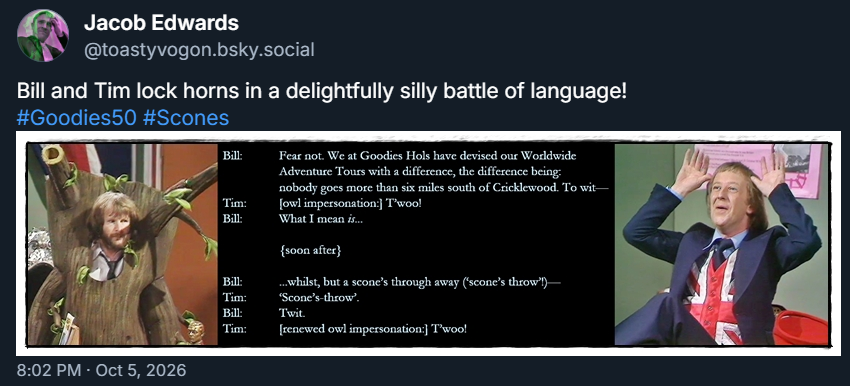
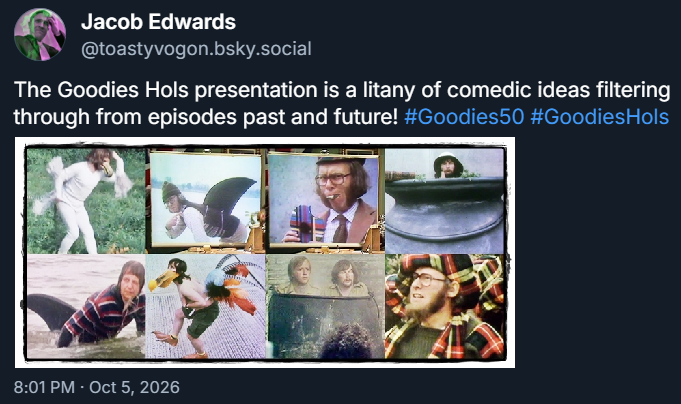
2. The self-referencing serves a purpose. As the BBC run grew ever more entrenched in the public consciousness, the Goodies became more and more prone to carry-over jokes. Hence, the resurfacing of Tim and Bill’s disagreement over the pronunciation of ‘scones/scones’—though here it is incorporated into a wider, wittier exchange:
Beyond this straightforward, associative humour, there seems also a deeper, edgier barb. ‘Daylight Robbery’ (itself a title worth unpicking) can also be taken as a critique of performance expectations and comedic legitimacy, as if the Goodies, in their own estimation, have become public figures built around self-devised stereotypes; and where ‘Hype Pressure’ focussed on their high-profile (if short-lived, novelty) real-world pop music success, ‘Daylight Robbery’ examines instead the more enduring casting of semi-fictional Graeme (glasses), Tim (Union Jack waistcoat) and Bill (scruffy beard), and considers both how much of themselves are caught up in these personas, and whether what they are doing (as comedians) is genuine/witty/imitable. Notably, the fake Goodies end the episode not just thwarted but also, at the moment of acclaim, sinking without trace, while the real Goodies finally triumph at Cannes—being judged most boring!
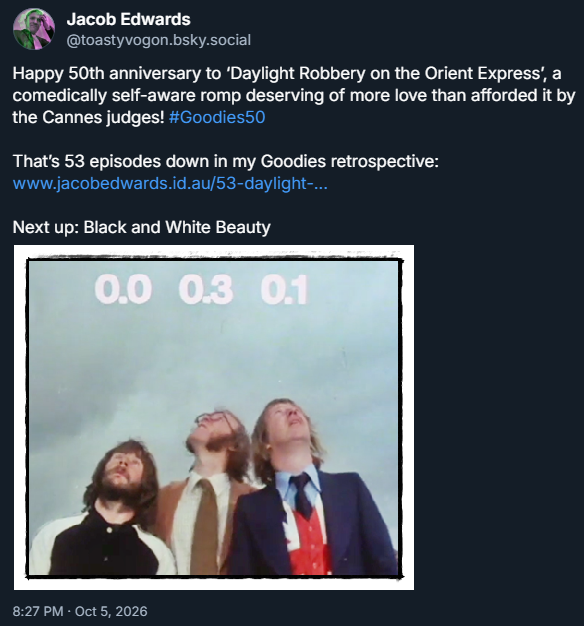
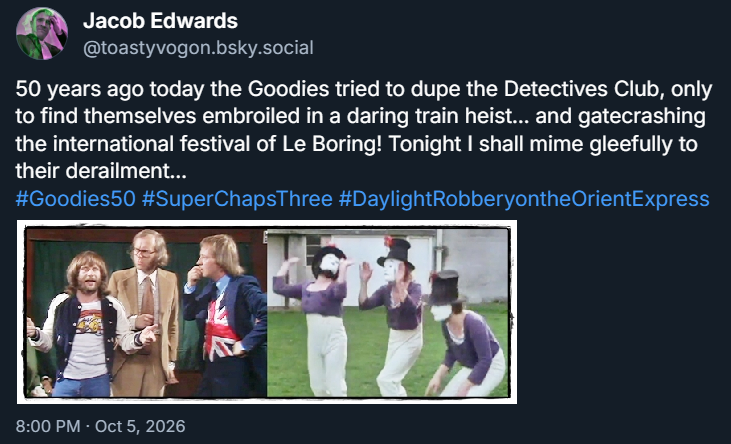
3. The zany entwining of ideas. In ‘Daylight Robbery’, the Super Chaps take two highly specific, unrelated plot strands and twist them together. This, of course, had long been their modus operandi, but in this instance they tinker to a new extent/extreme. ‘Murder on the Orient Express’, released as a film in 1974, can be linked to the Cannes Film Festival. So far, so good. The lads then re-brand Cannes as a celebration of performance-induced boredom, and both recast the link (citing the length of the movie[2]) and warp it into absurdity (the French mime rendition[3]). However, ‘Murder on the Orient Express’ is also used as an exemplar representing detective genre types more broadly, and it is in embodied piss-take of these that the theft of the Goodies’ fake train becomes subject to the improbable plot contrivances of crime writers’ authorial convenience—taking them wherever and however the storyline demands (the train carriage hoisted at one point by two helicopters!) until at last provided a denouement courtesy of the one character the reader/viewer had no reason to suspect: the goat! (Itself included in the Goodies’ original endeavour for no discernible reason, the incongruity of its presence concealed behind gags.) The Goodies, then, didn’t just poke fun at the genre; they did so while and by placing themselves within (and then pushing against) its operational constraints. In nested doll fashion, the same can be seen in their lampooning of Cannes. On a superficial level, this might be taken as a one-note joke, but actually Cannes can be taken as standing for the entertainment industry more generally, and again the Goodies cast their satirical piss-take against, yet also from within, these workings. Are they themselves to be taken seriously? The lot of any long-lived performer is to be cruelled by paradox—to be at all times true to what they have been, while at the same time always innovating. To change, while staying the same. To repeat for nostalgic pleasure of existing fans and yet appeal also to the new. In other words, to make boring brilliant. The Super Chaps, being delightfully self-aware, conclude that they are doomed in this endeavour: the episode itself is ultimately made subject to the Cannes judges’ unforgiving appraisal:
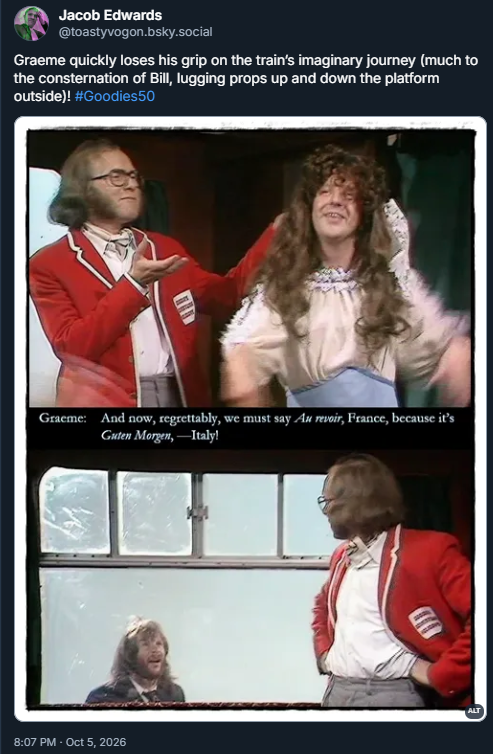
All of this is highly metatextual—and rather ahead of its time! It’s a different type of funny to the usual fare: less accessible, less immediate in engaging the viewer. Of course, that isn’t to say it lacked for comedic flourishes: Bill’s hobbling efforts to fake a cross-channel train journey by lugging props up and down the platform; Tim’s expression when pre-empted in a costume change (Graeme: “And so, it’s goodbye, Yugoslavia!”); the various bits of goat-related silliness.
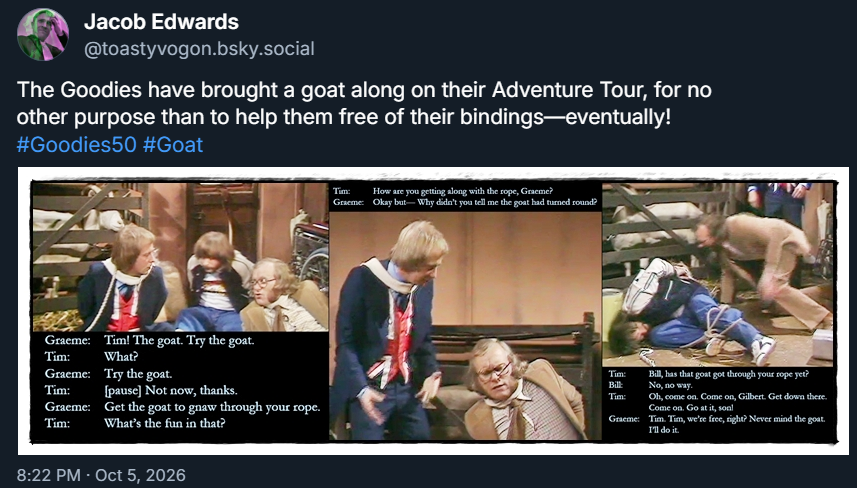
All-told, ‘Daylight Robbery’ romps along with a free-flowing, almost cavalier, gag-making spirit, yet with a depth, too, that repays consideration from well outside the box.
I, for one, retain an odd fondness for it!
Jacob Edwards, 5 October 2026
Tweets:
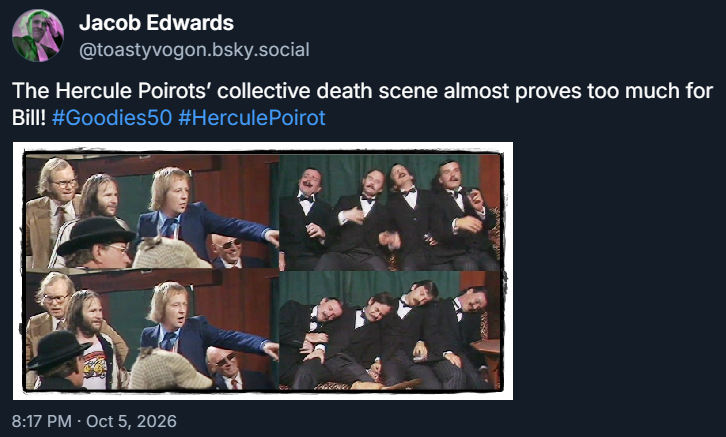
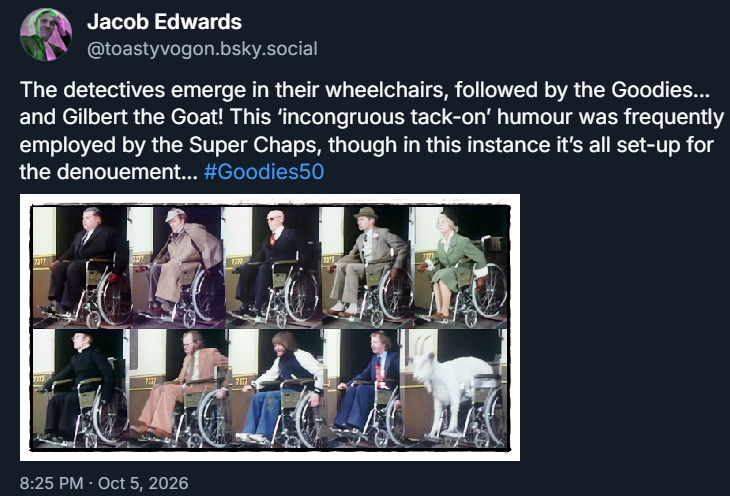
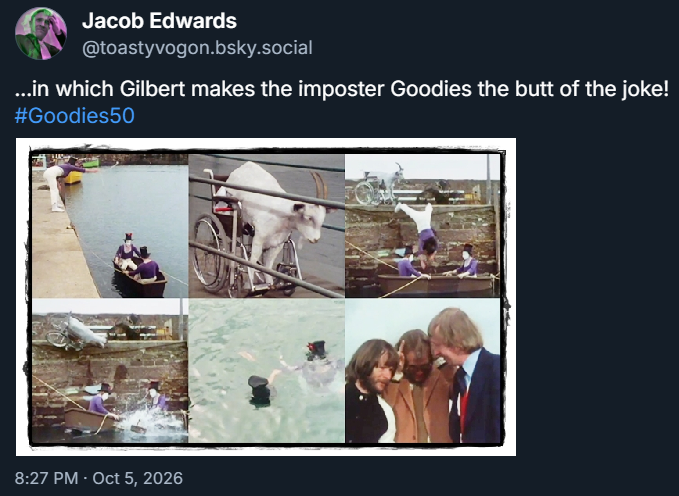
Previous: Hype Pressure
Next: Black and White Beauty
[1] And I’m aware here the ‘Daylight Robbery’ has its detractors. Cue the usual disclaimer re subjectivity.
[2] “All six-and-a-half hours of it!”
[3] Turning this still further on its head, the Super Chaps were not, themselves, infrequent practitioners of the French mime technique. As in previous Goodies episodes, once they engage with the medium, it loses any inherent dullness and becomes good for a number of gags.